
Untapped’s website renovation: Easy Surf’s accessibility testers make an accessible website design even better
Easy Surf partnered with Untapped Accessibility to review the accessibility of the refreshed website and ensure an excellent experience for people with disabilities.
Easy Surf conducted a conformance audit of the site alongside usability testing with assistive technology users: a screen reader user who is blind, and a speech-recognition user who navigates the web hands-free.
The audit and test recommendations were implemented and then verified by the Easy Surf team. This process led to a website that creates an inclusive and welcoming experience for people with disabilities.
The approach
Easy Surf combined a conformance audit with feedback from people with disabilities. This allowed them to assess both technical conformance and how the website performs for people using assistive technologies.
Conformance audit
The audit process combined automated scans, manual code inspections, and hands-on testing using assistive technologies such as screen readers, magnification tools, voice controls, and keyboard navigation.
Automated scanning tools are useful for identifying common, programmatic issues, but often provide false positives, cannot test for many issues, and cannot assess interaction quality, clarity, or consistency.
Manual testing and code inspection are used to examine how components behave within context, how focus moves through the page, and whether processes and interactions are predictable, convenient and robust.
User testing
Technical audits are best supported with testing with people with disabilities. For Untapped Accessibility’s website, user testing with a screen reader user and a speech-recognition user provided additional insights.
Screen reader testing highlighted issues related to structure, semantics, labelling, and reading order. Speech-recognition testing surfaced barriers caused by cumbersome interaction patterns.
While these are not the only assistive technologies or disability groups, they frequently identify barriers that standard conformance audits miss.
Verification process
Easy Surf then reviewed the implemented changes, verified fixes, and iterated with the development team until the site met accessibility standards and delivered a consistent, usable experience.
The results
Easy Surf explored what was already working, identified remaining barriers, and confirmed that fixes genuinely improved usability for people using assistive technologies.
What already worked well
Clear and usable navigation
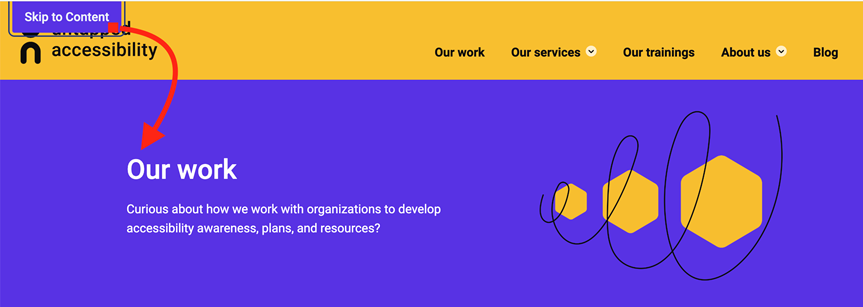
The main navigation uses arrows to show when a menu item is expanded into a submenu. This visual cue helps people with disabilities who benefit from a predictable structure. Importantly, submenus can be opened with a click rather than requiring hover interaction.
Hover-only interactions create barriers for users of speech-recognition software, people with motor-control disabilities, and people who use magnification software. Supporting a click-based interaction ensures the navigation is operable across a wider range of access methods.
Meaningful skip links
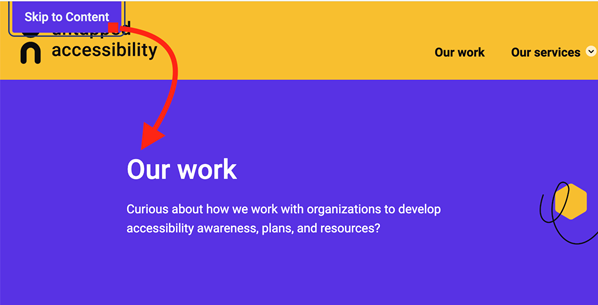
The presence of the ‘Skip to content’ link helps keyboard and screen reader users bypass repetitive content and quickly reach key areas. These links indicate that the site has been designed with an accessibility-first mindset.
Implemented recommendations
1. Accordions improved
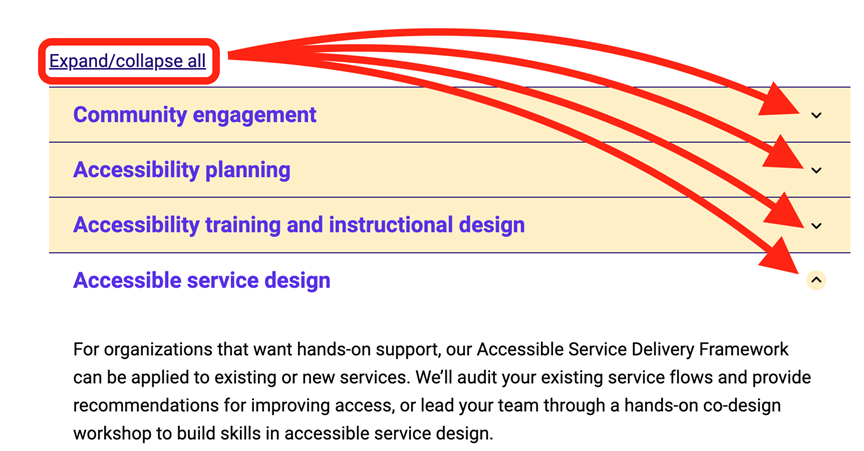
Before the fixes were implemented, accordion sections closed automatically when a new section was opened.
Easy Surf recommended allowing multiple accordion sections to stay open and adding ‘Expand all’ and ‘Collapse all’ buttons.
This allows users to:
- Browse all information at once with less opening and closing.
- Use “Ctrl+F” or other text search tools to find specific words or sections.
- Maintain context while navigating longer or more complex information.
While not strictly required for WCAG conformance, these improvements significantly enhance usability, particularly for people with cognitive disabilities, screen reader users, and users who benefit from reduced interaction effort.
2. Focus order adjusted on the blog page
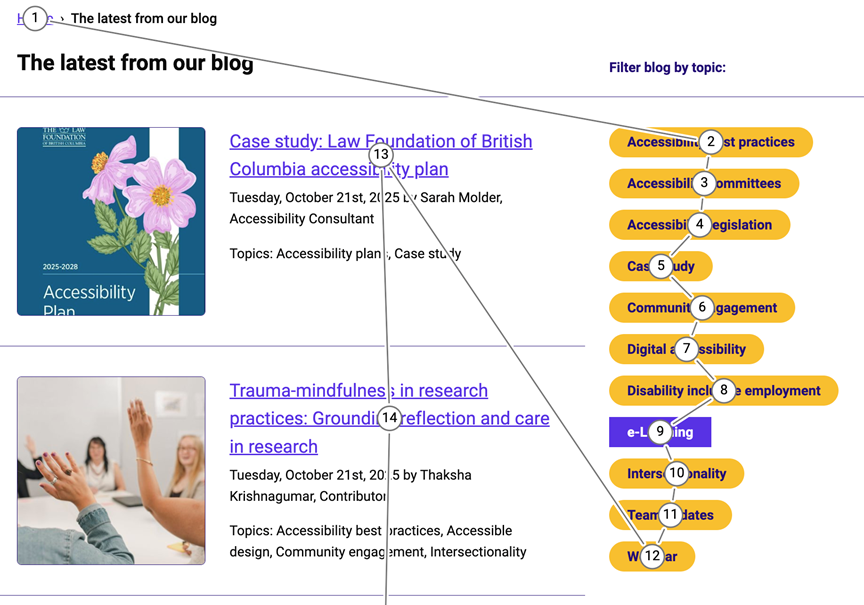
Previously, keyboard and screen reader users encountered the full list of blog posts before reaching the “Filter blog by topic” section. This made the filter easy to miss and required navigating through many blog cards to reach it.
The focus order has been updated so that assistive technology users can reach the filter controls sooner. This allows users to filter content before navigating results, improving efficiency and reducing unnecessary interactions.
3. CAPTCHA removed on the contact form
The previous contact form included a CAPTCHA, which created barriers for screen reader users. Assistive technologies often interact with CAPTCHA systems in ways that are misinterpreted as suspicious behaviour, making CAPTCHA accessibility a longstanding challenge.
The CAPTCHA has now been removed, and its security function has been replaced with Cloudflare, which provides the same level of security without introducing barriers for users with disabilities. This change improves form accessibility while maintaining appropriate protection against spam and abuse.
The Accessibility Conformance Report
Because accessibility was considered throughout the redesign process, the audit and testing focused more on refinement than on fundamental change.
Untapped’s refreshed site conforms to WCAG 2.2 Level AA, with two exceptions due to third-party components. The issues are caused by an external form used as one of several contact options. Untapped is exploring ways to address these issues and, in the meantime, encourages visitors to contact via email or phone.
Easy Surf concluded the project by creating an Accessibility Conformance Report, completing the WCAG edition of the Voluntary Product Accessibility Template (VPAT). This standardized document is the leading reporting format for accessibility standards. If you would like a copy of the full VPAT, please email [email protected].
If you’re building or refreshing a website, reach out to Untapped Accessibility or Easy Surf!
Charlie Morris (he/him) is Web Accessibility Lead & Developer at Easy Surf. After acquiring a life-long disability and chronic illness as a young adult, Charlie has both lived experience as a person with disability and a plethora of professional experience as a web developer, teacher, consultant, business owner, and accessibility specialist.